Vol. 1, No. 6Thursday, October 22, 2026Not a real newspaper

The 401(k) Liar

America's Least Trusted Source for Retirement Plan News

Guaranteed* Edition

Breaking · Risk Management

Insurer Unveils First Product Its Actuaries Are Comfortable Giving Away

Halverson’s free fiduciary warranty wins unanimous approval from the people whose job is to make sure Halverson never takes an unpriced risk.

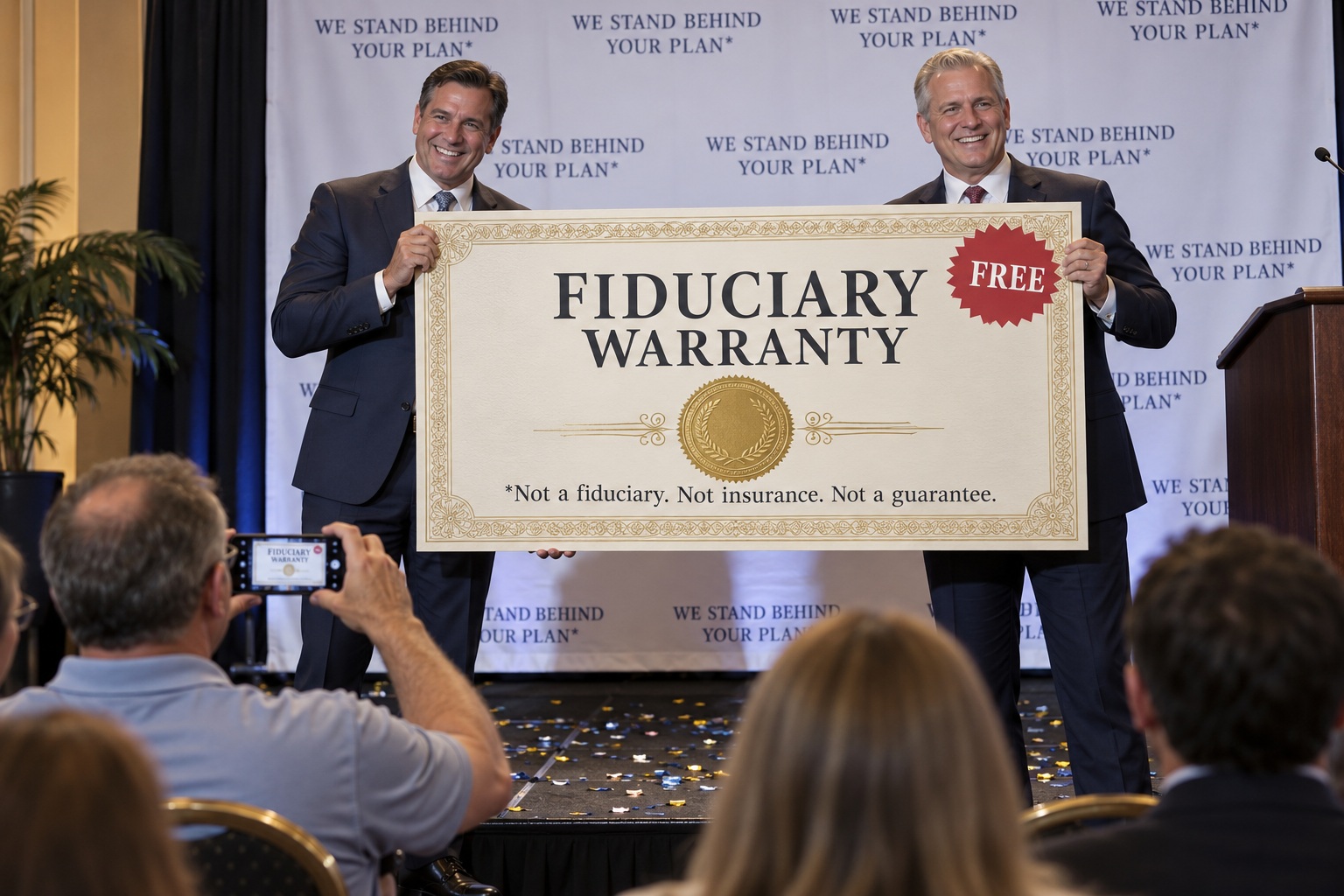
Two smiling insurance executives on a hotel ballroom stage hold a giant certificate reading Fiduciary Warranty with a red FREE sticker, the small print along the bottom reading Not a fiduciary. Not insurance. Not a guarantee. The banner behind them repeats We Stand Behind Your Plan with an asterisk. A man in the front row photographs the small print.
Halverson executives display the product following a review in which every department found something to be pleased about.AI-generated satirical photo illustration

Halverson Mutual Life unveiled a free fiduciary warranty Wednesday after an exhaustive actuarial review confirmed the company could afford to give one to every retirement plan in America.

The insurer, which employs 240 people to calculate what could go wrong, said none had raised an objection.

“We can tell you what it costs to insure a diabetic roofer who rides a motorcycle,” said chief actuary Ellen Voss. “We didn’t just shrug and put ‘free’ on this.”

Voss’s team tested the warranty against falling markets, excessive fees, imprudent investment selections, and a complete collapse of the retirement system. In every scenario, Halverson still had its money. The only projected loss involved ordering more certificates than it needed.

An early draft had briefly allowed for a payment. General counsel located the sentence, and the launch stayed on schedule.

At an internal demonstration, the claims director stamped a sample request DENIED and passed it down the table. Legal approved it. Operations confirmed it could be automated. Sales asked whether the stamp would appear anywhere in the brochure.

“We did not build a ninety-four-year-old insurance company by forgetting to charge for risk.”— Carl Dressler, Senior Vice President

The warranty will appear prominently in proposals, where it is expected to discourage further questions about fiduciary responsibility. Its explanation will appear in a separate document, available upon request.

Dressler said the product had already improved cooperation between departments. Marketing wanted clients to feel protected. Legal wanted the company to be protected. Neither had been asked to compromise.

The launch concluded with champagne and a photograph of two executives holding the certificate. Before signing the ballroom contract, Halverson purchased liability insurance for the event.


Developing · Product Recall

Insurer Recalls Brochure After Employee Accidentally Writes a Sentence That Means Something

Halverson Mutual Life recalled 312 copies of its new fiduciary warranty brochure Thursday after a junior copywriter removed enough qualifying language to leave the company apparently agreeing to do something.

The error was discovered when a regional sales director read the paragraph aloud and understood it on the first attempt.

“There was a subject, a verb, and then a thing we were going to do,” said associate counsel Deborah Fenn. “You could take that into court.”

Account managers were instructed to retrieve every copy without describing the revision as a change in coverage, an admission of error, or an improvement. One asked what he should say if a client wanted to know why. Fenn told him to call from the parking lot.

The copywriter said he had been following instructions to make the brochure “more direct.” His manager said the instruction had referred to the photograph of the executives looking into the camera.

By afternoon, counsel had restored the paragraph to 146 words. A sales representative read it twice and asked whether it meant anything.

Fenn authorized printing.


Around the Industry

Retirement Researchers Forced to Exclude Woman Who Needs Her Paycheck

A university retirement research center removed payroll clerk Denise Harlow from its savings study Tuesday after she continued spending money the model had assigned to her future.

Harlow, 46, received the same encouraging messages, simplified choices, and photograph of a couple on a sailboat as the other participants. She nevertheless paid her electric bill.

“Denise understood the benefits of increasing her contribution,” said researcher Philip Crane. “That’s what makes her behavior so difficult to explain.”

Researchers offered Harlow $75 for a follow-up interview. She used it to make a car payment, prompting the team to classify her as unusually responsive to financial incentives.

The paper concludes that more education is needed. Harlow has asked whether the next interview also pays.

Retiring Advisor Requests Three-Year Track Record Before Acknowledging Daughter Beat Him at Golf

Retirement consultant Chad Hartwell declined to recognize his fifteen-year-old daughter’s victory Saturday, citing a sample size of one round.

“Anybody can have a good afternoon,” said Hartwell, 62, who has kept a photograph of his 2009 hole-in-one on his desk for seventeen years.

Maya beat him again Sunday. Hartwell requested a longer measurement period. She produced scorecards from July and August. He noted that both had been signed by her mother, whose independence he questioned.

Hartwell has postponed his retirement party until the results can be put in context.

Maya has offered him two strokes. He has asked that the offer remain confidential.

Economist’s Golden Age of Universal Pensions Turns Out to Be Three Men Who Worked With Her Father

Professor Helen Marsh’s account of an America in which every worker retired with a comfortable pension narrowed considerably Tuesday when a moderator asked her to describe the workers.

They were her father, Richard from his department, and two men named Alan.

“The point is that ordinary people had security,” said Marsh, who recalled all four buying second homes within a year of retiring. “Nobody was sitting around worrying about their 401(k).”

A dining-hall employee asked whether the people who served their lunch had the same arrangement. Marsh said individual anecdotes were not a useful basis for national policy.

The moderator thanked her for putting a human face on the data.